
 Platforms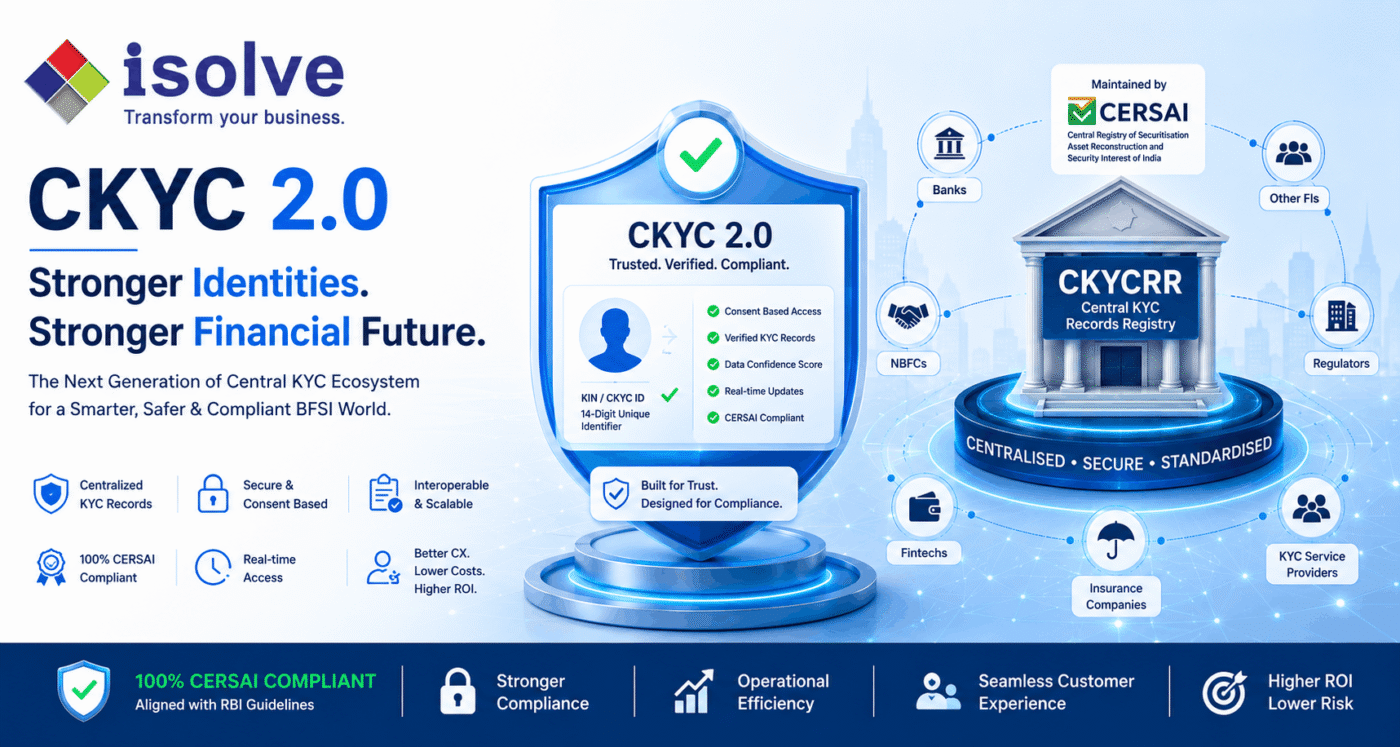
For years, India’s financial institutions have invested heavily in KYC processes.
Customers submitted PAN, Aadhaar, passports, address proofs, photographs and other documents to banks, NBFCs, insurers, mutual funds and other financial institutions—often repeatedly.
The Central KYC ecosystem was created to solve exactly this problem.
Instead of asking a customer to complete the same KYC exercise every time they approach another regulated financial institution, the Central KYC Records Registry (CKYCRR) enables KYC information to be centrally maintained and made available to Reporting Entities under the applicable regulatory framework and customer consent requirements.
Now, the ecosystem is entering a new phase.
CKYC 2.0 is expected to make central KYC more usable, more connected and more data-driven—while putting greater emphasis on data quality, consent, verification and interoperability.
Recent industry reporting indicates that the next-generation CKYC framework is being rolled out in phases, beginning with banks and insurers, with other financial sectors expected to participate as sector-specific requirements are finalised. Reported enhancements include consent-based access, confidence scoring for KYC data and improved cross-institution usability.
For BFSI organisations, this is more than a technology upgrade.
It is a change in how customer identity can be managed across the financial ecosystem.
And that raises an important question:
Is your organisation’s KYC infrastructure ready for the next generation of CKYC?
CKYC stands for Central Know Your Customer.
It is India’s centralised KYC framework designed to allow customer KYC information to be maintained in a common registry and reused across participating regulated financial institutions, subject to the applicable regulatory requirements and customer consent.
The objective is simple:
Perform KYC efficiently once, maintain a reliable central record and reduce unnecessary repetition across financial relationships.
A customer who has already completed KYC with one financial institution should not have to repeatedly start the entire identification process from zero when approaching another institution, wherever the regulatory framework permits retrieval and reuse of the existing KYC record.
This helps create a more efficient customer journey while supporting the broader objectives of:
- Faster customer onboarding
- Reduced paperwork
- Better KYC data management
- Improved regulatory reporting
- Reduced duplication
- Better customer experience
- More consistent customer information across institutions
CKYCRR stands for Central KYC Records Registry.
It is the central infrastructure through which KYC records are stored, processed, retrieved and updated within the Central KYC ecosystem.
A simple way to understand the difference is:
CKYC = the central KYC framework and customer KYC record
CKYCRR = the central registry/infrastructure that manages those KYC records
The Government of India authorised the Central Registry of Securitisation Asset Reconstruction and Security Interest of India (CERSAI) to act as and perform the functions of the CKYCRR through Gazette Notification S.O. 3183(E), dated November 26, 2015. RBI’s KYC Master Direction also explicitly identifies CERSAI as the entity authorised to perform CKYCRR functions.
The CKYCRR therefore forms a critical piece of India’s financial KYC infrastructure.
One of the most common misconceptions is that RBI itself operates the CKYC registry.
The roles are different.
CERSAI — Registry Operator
CERSAI is authorised to act as the Central KYC Records Registry.
It operates the CKYCR infrastructure and provides the mechanisms through which Reporting Entities can submit, search, retrieve and update KYC information.
RBI — Banking and NBFC Regulatory Oversight
RBI establishes KYC requirements for entities under its regulatory jurisdiction, including banks and applicable NBFCs.
Its KYC Master Direction requires regulated entities to capture and upload customer KYC information to CKYCR and retrieve KYC records where applicable.
SEBI — Securities Market
SEBI establishes KYC requirements for entities operating within the securities market.
SEBI has also issued directions concerning the uploading of KYC information by KYC Registration Agencies to CKYCRR.
IRDAI — Insurance
Insurance-sector entities operate within the KYC and AML requirements applicable to their regulatory framework.
PFRDA — Pension Sector
PFRDA regulates KYC requirements applicable to entities within the pension ecosystem.
Reporting Entities — The Operational Participants
Banks, NBFCs, insurers and other applicable Reporting Entities are responsible for performing their KYC obligations and ensuring that information is appropriately captured, verified, uploaded, updated and retrieved in accordance with the rules applicable to them.
In simple terms:
CERSAI operates the central registry. Regulators establish and enforce requirements for their regulated entities. Reporting Entities are responsible for executing their KYC obligations correctly.
That distinction is important because implementing a technology platform does not transfer the regulatory responsibility away from the Reporting Entity.
Before central KYC, the same customer could have multiple KYC journeys across different financial institutions.
For example:
Customer → Bank → KYC
Then:
Same Customer → NBFC → New KYC
Then:
Same Customer → Insurance Company → Another KYC
Then:
Same Customer → Mutual Fund → Another KYC
This creates:
- Duplicate documentation
- Repeated verification
- Higher operational costs
- Longer onboarding journeys
- More manual intervention
- Inconsistent customer data
- Higher chances of data-entry errors
The central KYC ecosystem attempts to address this by creating a shared KYC infrastructure.
1. Centralised KYC Records
CKYCRR provides a central repository for KYC information submitted by Reporting Entities.
This enables eligible institutions to retrieve existing KYC information rather than unnecessarily recreating the entire customer KYC process.
2. Unique CKYC Identifier / KIN
A customer record in the CKYC ecosystem is associated with a 14-digit CKYC Identifier Number (KIN).
The identifier helps institutions locate the relevant customer record within the central registry.
For financial institutions, the KIN becomes an important reference point for:
- KYC retrieval
- Customer onboarding
- KYC updates
- Record management
- Compliance operations
3. KYC Search and Retrieval
Reporting Entities can search for and retrieve customer KYC information through the mechanisms provided by CKYCRR.
This can significantly reduce unnecessary document collection and manual verification when a valid central KYC record already exists.
RBI’s KYC framework specifically provides for retrieval of KYC records online from CKYCR where the KYC Identifier is used with appropriate customer consent.
4. KYC Record Updates
CKYC is not intended to be a one-time static database.
Customer information changes.
Addresses change.
Names change.
Contact information changes.
Documents get renewed.
KYC status can change.
RBI’s framework requires regulated entities to provide updated information to CKYCR within the applicable prescribed period and requires entities to retrieve updated records when CKYCR communicates that a customer’s KYC record has been updated.
This makes KYC update management a critical part of CKYC compliance.
5. Centralised Data Sharing
The broader objective of CKYC is to enable controlled sharing and reuse of KYC information across participating financial institutions.
This can create a much smoother experience for customers who already have a verified KYC record.
The term CKYC 2.0 is increasingly being used to describe the next-generation Central KYC ecosystem.
It is important to make one distinction:
CKYC 2.0 should not be treated as simply a new version number of a software API.
It represents a broader evolution toward:
- Better-quality central KYC data
- Consent-driven access
- More reliable verification
- Greater interoperability
- Improved data confidence
- Faster customer onboarding
- Better update mechanisms
- Wider participation across financial sectors
Recent reporting on India’s next-generation CKYC system indicates that customer consent and data-confidence scoring are central components of the new model, with banks and insurers expected to be among the early participants and capital-market entities joining as sector-specific requirements are completed.
CKYCRR 1.0 vs CKYC 2.0: What Is Changing?
| Area | Traditional CKYC / CKYCRR | CKYC 2.0 Direction |
|---|---|---|
| KYC approach | Centralised KYC repository | More intelligent customer identity layer |
| Data | Record-centric | More structured and quality-aware |
| Customer consent | Existing regulatory mechanisms | Stronger consent-driven access |
| Data confidence | Limited visibility | Confidence/quality indicators |
| Verification | Institution-dependent workflows | Greater emphasis on verified data |
| Onboarding | Retrieve + validate | Faster consent-based retrieval |
| Updates | Central registry updates | Greater focus on near real-time data usability |
| Duplication | Existing challenge | Better matching and data-quality controls |
| Cross-sector usage | Uneven adoption | Broader financial ecosystem participation |
| Customer experience | Repeat KYC can still occur | “Verify once, reuse where permitted” experience |
The exact implementation, timelines and sector applicability should always be checked against the latest communication issued by the relevant regulator and CKYCRR/CERSAI.
The central challenge was never simply:
“Where do we store KYC data?”
The bigger question is:
“Can a financial institution trust the KYC data it retrieves?”
This is where CKYC 2.0 becomes strategically important.
Recent reporting says that the new system is expected to introduce a confidence score that can indicate the reliability of customer information and whether the information has already been verified by a financial institution.
This can help institutions make better decisions around:
- Data reliability
- Verification requirements
- Onboarding workflows
- Exception handling
- Fraud controls
- Re-KYC requirements
In other words:
CKYC 2.0 is moving the ecosystem from “centralised KYC data” toward “trusted, consented and usable KYC data.”
Customer Consent Becomes Even More Important
A centralised KYC system cannot work simply by giving institutions unrestricted access to customer information.
Consent matters.
Recent reporting on the CKYC 2.0 framework indicates that financial institutions will need customer consent through OTP before accessing verified central KYC information.
This creates a new responsibility for financial institutions:
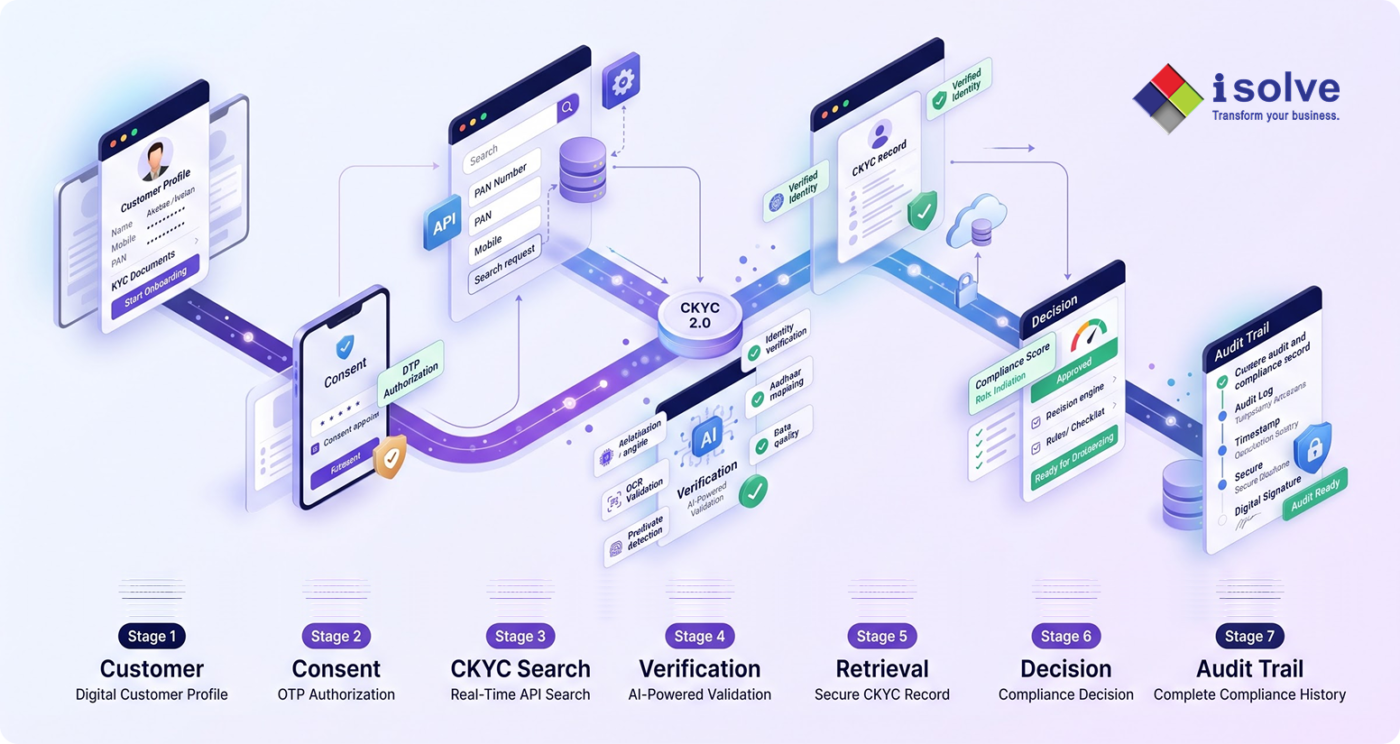
Your onboarding journey must connect:
Customer → Consent → CKYC Search → Verification → Retrieval → Decision → Audit Trail
A compliant CKYC implementation therefore needs more than a basic API connection.
It needs a properly designed consent and audit workflow.
For BFSI organisations, CKYC 2.0 Verification can impact multiple areas simultaneously.
Customer Onboarding
Instead of repeatedly collecting documents, institutions can use existing KYC information where permitted.
Potential impact:
- Faster onboarding
- Reduced customer drop-offs
- Less document handling
- Lower manual verification workload
Loan Origination
For NBFCs and digital lenders, KYC is one of the first major checkpoints in the lending journey.
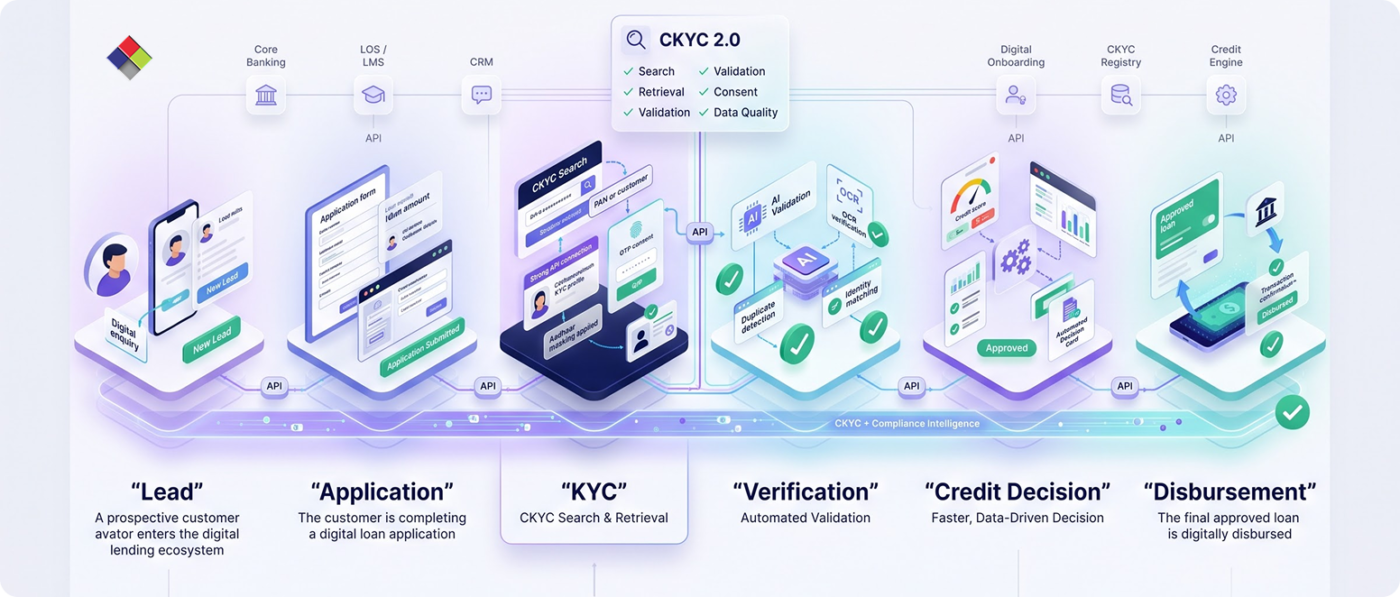
A more connected CKYC process can help reduce friction between:
Lead → Application → KYC → Verification → Credit Decision → Disbursement
The faster the KYC process becomes without compromising controls, the faster the customer can progress through the lending journey.
Banking
Banks manage enormous volumes of customer onboarding and periodic KYC activities.
CKYC automation can help operational teams manage:
- New customer KYC
- Existing customer KYC
- KYC retrieval
- KYC updates
- Duplicate detection
- Exception management
- Compliance reporting
Insurance
Insurance companies can potentially benefit from reusable customer identity information during:
- Policy onboarding
- Customer servicing
- Policy updates
- Renewal
- Cross-selling
- Re-KYC
Fintech
For fintech companies working with regulated entities, CKYC becomes an important component of the broader digital onboarding architecture.
Instead of building a fragmented KYC workflow, fintechs can integrate CKYC capabilities into:
Digital onboarding + identity verification + consent + CKYCRR + compliance + audit
CKYC 2.0 Ecosystem
The future CKYC ecosystem can be visualised as a connected financial identity network.
The technology layer connecting the institution to the central ecosystem becomes increasingly important.
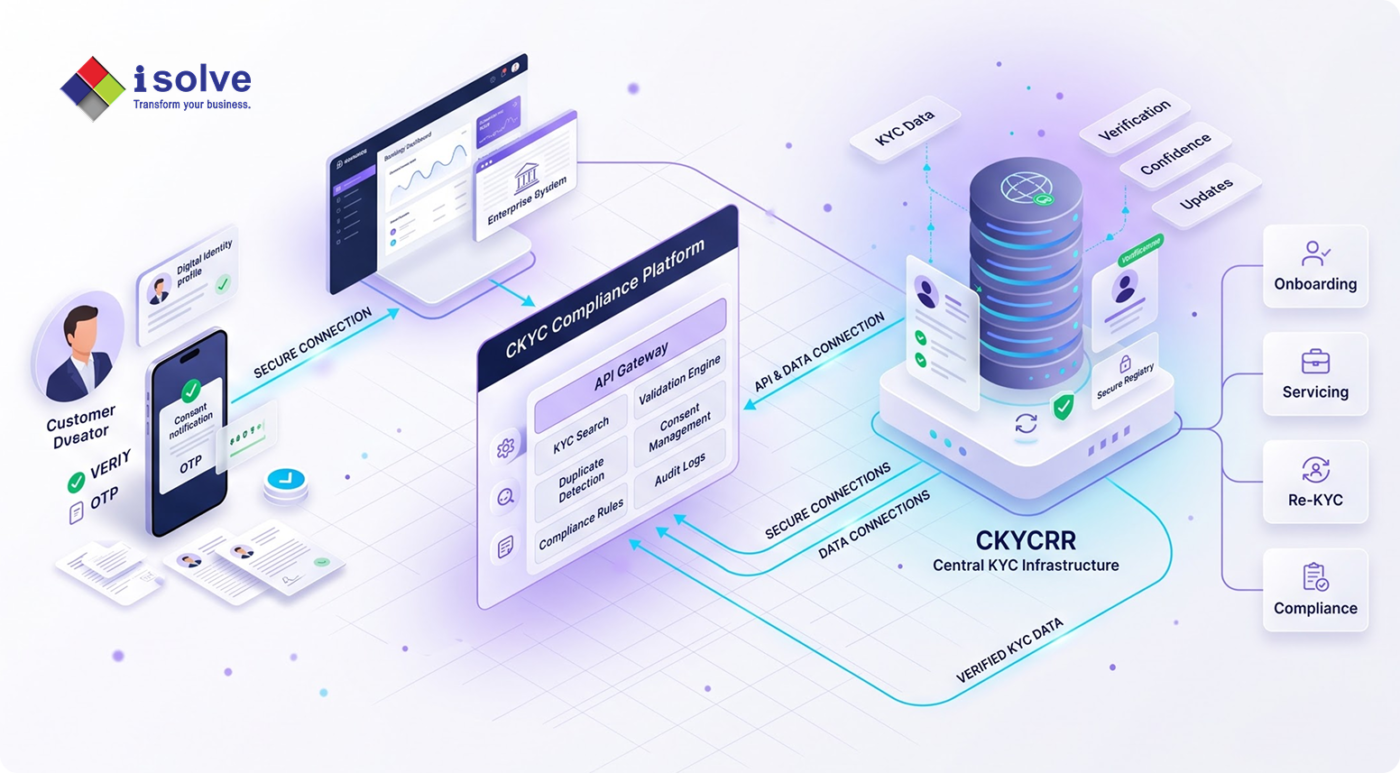
A modern CKYC platform should not simply “upload files.”
It should manage the complete CKYC lifecycle.
1. CKYC Search
Search existing customer records before creating a new record.
2. CKYC Download
Retrieve available customer KYC information through approved integration mechanisms.
3. Customer Consent
Capture and record the required consent before accessing KYC information.
4. KYC Data Validation
Validate mandatory fields and data quality before submission.
5. Aadhaar Data Protection
Ensure Aadhaar-related information is handled according to applicable regulatory and security requirements, including appropriate masking where required.
6. CKYC Upload
Submit KYC information to CKYCR using the applicable CERSAI-defined formats and integration mechanisms.
7. Rejection Management
Identify rejected records and provide actionable reasons for correction.
8. Duplicate Management
Detect potential duplicate customers and prevent unnecessary creation of new KYC records.
9. KYC Update
Automatically manage customer KYC changes and updates.
10. Re-KYC / Periodic KYC
Support institutions in managing periodic KYC updation requirements.
11. Audit Trail
Maintain a complete record of:
- Search
- Consent
- Download
- Upload
- Update
- Rejection
- Correction
- Resubmission
12. Compliance Dashboard
Give compliance and operations teams visibility into:
- Total submissions
- Successful records
- Rejected records
- Pending records
- Updated records
- Duplicate cases
- SLA breaches
- Error trends
Why Manual CKYC Operations Are Becoming Risky
A spreadsheet-based CKYC process may work at a small scale.
But as customer volumes increase, manual processing creates significant operational risk.
Imagine processing:
10,000 KYC records per month
Then:
50,000
Then:
1,00,000+
Manual processes can quickly result in:
- Data-entry errors
- Incorrect templates
- Duplicate records
- Missing fields
- Upload failures
- Delayed updates
- Unresolved rejection queues
- Poor audit visibility
- Increased operational cost
The problem is not only the number of records.
It is the number of exceptions.
A strong CKYC platform therefore needs to automate the normal journey while intelligently routing exceptions to the right operational team.
The ROI of CKYC 2.0 Automation
CKYC automation should not be evaluated only as a compliance expenditure.
It can also be viewed as a customer acquisition and operational efficiency investment.
ROI Area 1: Lower KYC Processing Cost
Automation reduces repetitive manual activities such as:
- Data entry
- Document checking
- File preparation
- Search
- Upload
- Error identification
- Status tracking
ROI Area 2: Faster Customer Onboarding
A smoother KYC process means customers can move faster toward:
- Account opening
- Loan approval
- Insurance purchase
- Investment
- Other financial products
ROI Area 3: Reduced Customer Drop-Off
Every additional form and document request creates friction.
A simpler KYC experience can improve conversion across digital financial journeys.
ROI Area 4: Lower Compliance Operations Cost
Automated workflows can reduce the amount of manual effort required for:
- Reconciliation
- Rejections
- Updates
- Monitoring
- Reporting
ROI Area 5: Better Data Quality
Poor KYC data creates downstream problems.
Better validation at the point of submission can reduce:
Bad data → rejection → manual correction → resubmission → delay
ROI Area 6: Better Audit Readiness
Instead of searching across emails, spreadsheets and multiple systems, compliance teams can access a central audit trail.
That improves operational visibility and governance.
A Simple CKYC ROI Model
Financial institutions can calculate potential CKYC automation ROI using:
- Annual KYC Processing Cost
- Manual Operations Cost
- Rejection & Correction Cost
- Customer Drop-Off Cost
- Compliance Monitoring Cost
- Infrastructure / Integration Cost
Example
Suppose an NBFC processes:
1,00,000 KYC cases per year
If automation saves even 5 minutes of operational effort per case, that represents:
5,00,000 minutes
or approximately:
8,333 hours of operational effort.
The actual financial benefit will depend on staffing costs, process complexity, error rates, technology costs and the institution’s operating model.
This is why CKYC should be evaluated as a business-process transformation, not simply an API integration.
What Does “CERSAI Compliant” Really Mean?
This is an important distinction for every BFSI buyer.
A technology vendor should not simply claim:
“Our platform makes your organisation 100% compliant.”
Regulatory compliance ultimately depends on the institution’s:
- Policies
- Customer Due Diligence
- Data
- Processes
- Controls
- Technology implementation
- Regulatory interpretation
- Governance
- Operational execution
A technology platform can, however, be designed to support compliance with applicable CERSAI/CKYCRR requirements.
That is a much more credible way to evaluate a CKYC platform.
The right question is therefore not:
“Does your platform claim 100% compliance?”
Ask instead:
“How does your platform help us operationalise every applicable CKYCRR requirement and prove that the process was executed correctly?”Before selecting a CKYC technology partner, ask these questions:
Compliance
- Does the platform support applicable CKYCRR/CERSAI workflows?
- How are regulatory changes incorporated?
- How are CERSAI templates and requirements managed?
Integration
- Does it support API-based integration?
- Can it integrate with LOS, LMS, CRM and onboarding systems?
- Does it support bulk processing where applicable?
Data Quality
- Does the platform validate mandatory fields?
- Does it identify duplicate records?
- Does it detect errors before submission?
Security
- How is customer data protected?
- How is Aadhaar information handled?
- Are access controls and audit trails available?
Consent
- How is customer consent captured?
- Is consent linked to the CKYC retrieval event?
- Can the organisation demonstrate consent during an audit?
Operations
- Is there a rejection management workflow?
- Can operations teams track pending cases?
- Can compliance teams monitor SLA and exception status?
Scalability
- Can the platform handle your current volume?
- Can it handle 5X or 10X growth?
- What happens during peak onboarding periods?
Reporting
- Can management see CKYC performance in real time?
- Can compliance teams generate audit reports?
- Can teams identify recurring rejection reasons?
Before moving to CKYC 2.0, organisations should evaluate:
Technology Readiness
- API connectivity
- Secure integration architecture
- Real-time workflow capability
- Bulk processing capability
- System scalability
- Monitoring and alerting
Data Readiness
- Existing CKYC records
- Duplicate records
- Missing fields
- Incorrect customer information
- Legacy records
- KYC document quality
Process Readiness
- Search-before-create workflow
- Consent capture
- Download workflow
- Upload workflow
- Update workflow
- Rejection handling
- Exception management
Compliance Readiness
- Latest RBI requirements
- Applicable sector regulator requirements
- CERSAI operational guidelines
- KYC policy alignment
- Audit trail
- Customer communication
Business Readiness
- Onboarding volumes
- Current KYC cost
- Manual processing cost
- Rejection rate
- Customer drop-off
- Turnaround time
- Expected ROI
The long-term opportunity is much bigger than reducing paperwork.
CKYC has the potential to become a critical identity layer connecting multiple financial services.
Imagine a customer who has already established a verified financial identity.
Instead of repeatedly submitting documents:
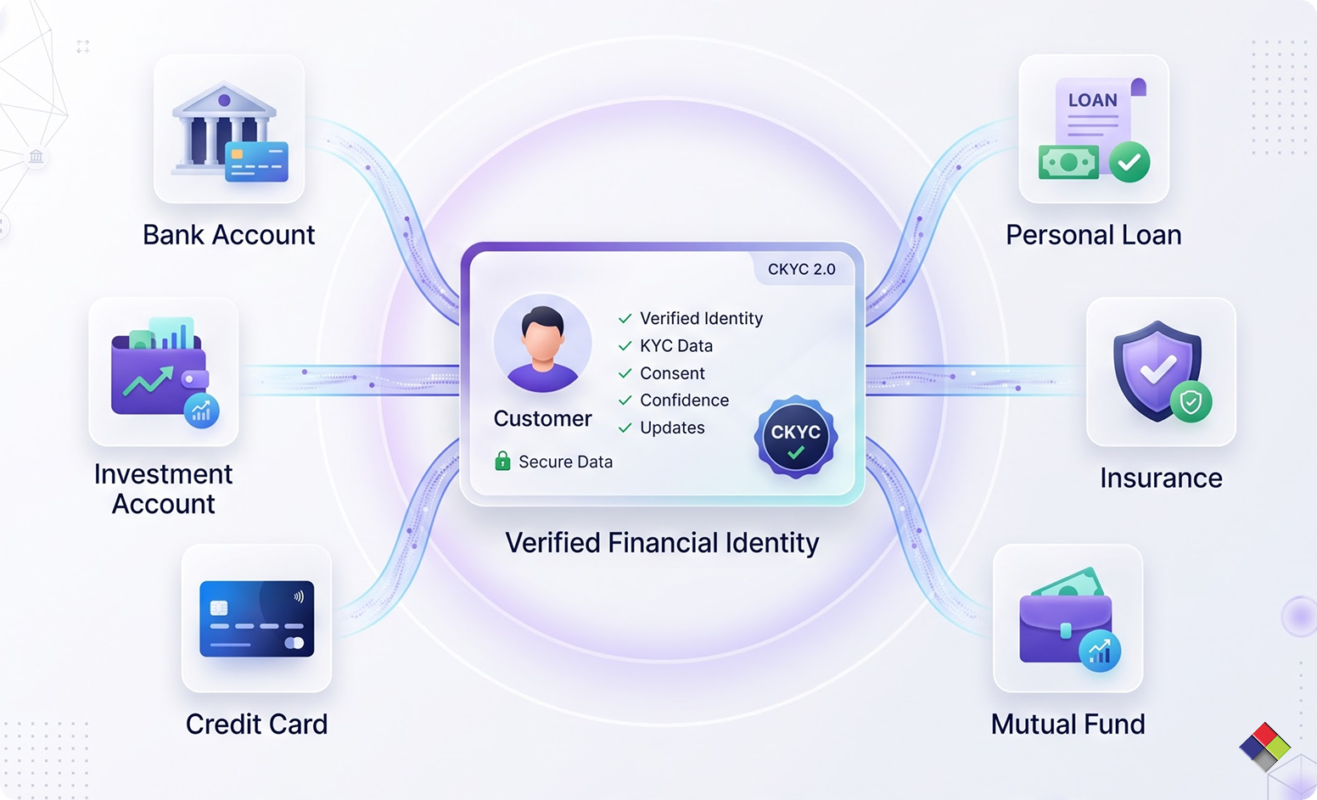
This can create a significant opportunity for India’s financial ecosystem.
Recent reporting estimates the central registry already contains around 1.2 billion records, while CKYC 2.0 is intended to address historic data-quality and adoption challenges through mechanisms such as confidence scoring and consent-based access.
The future is therefore not simply:
“KYC once.”
It is:
“Build a trusted financial identity that can be securely and responsibly reused.”
CKYC 2.0 and the Future of Digital Lending
Digital lending could be one of the biggest beneficiaries.
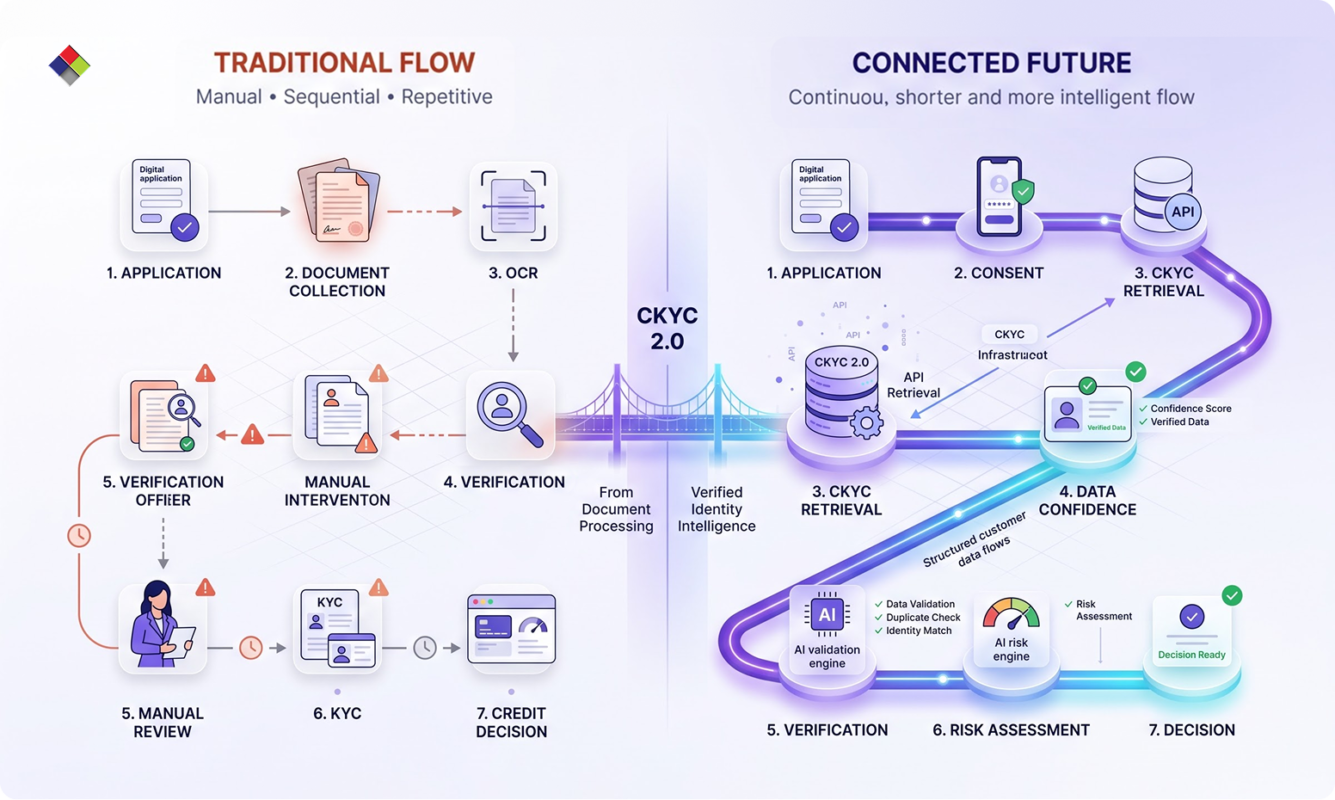
Consider a customer applying for a personal loan.
Traditional flow:
Application → Document Collection → OCR → Verification → Manual Review → KYC → Credit Decision
A more connected future could look like:
Application → Consent → CKYC Retrieval → Data Confidence → Verification → Risk Assessment → Decision
This can potentially reduce friction while allowing lenders to focus more operational effort on exceptions and risk rather than repetitive data collection.
CKYC 2.0 and Financial Inclusion
The business case goes beyond compliance.
India has achieved significant progress in basic banking access, but participation in products such as investments, insurance and pensions remains comparatively lower.
A reusable, trusted customer identity can reduce one of the barriers to entering additional financial products: repeated KYC friction.
Reuters reported in July 2026 that industry participants expect the new CKYC model to help expand access to financial products by reducing repeated documentation requirements.
That makes CKYC 2.0 relevant not only to compliance teams, but also to:
- Product teams
- Digital banking teams
- Lending teams
- Customer experience teams
- Growth teams
- Fintech platforms
- Distribution channels
CKYC 2.0 Is a Compliance Project — But It Is Also a Growth Project
This is the biggest strategic takeaway for BFSI leaders.
If KYC becomes faster:
Onboarding becomes faster.
If onboarding becomes easier:
Conversion can improve.
If customer identity can be reused:
Cross-sell becomes easier.
If data quality improves:
Operational exceptions can reduce.
If compliance becomes automated:
Teams can scale without increasing manual effort at the same rate.
Therefore:
CKYC 2.0 should not sit only with the compliance department. It should be treated as a joint initiative across Compliance, Operations, Technology, Product and Customer Experience.
How a CKYC Compliance Platform Can Help
A modern CKYC compliance platform can act as the orchestration layer between your customer onboarding systems and the central KYC ecosystem.
Your existing systems
LOS | LMS | CRM | Digital Onboarding | Mobile App | Web App
↓
CKYC Compliance Platform
Search | Consent | Download | Validate | Upload | Update | Deduplicate | Re-KYC | Rejection Management | Audit
↓
CKYCRR / CERSAI Ecosystem
This architecture allows financial institutions to centralise CKYC operations while integrating with their existing business systems.
Why Choose an Automated CKYC 2.0 Platform?
Your organisation should not have to build every CKYC workflow from scratch.
A purpose-built platform can help you:
Automate
Reduce repetitive manual CKYC activities.
Validate
Identify data and document issues before submission.
Integrate
Connect CKYC workflows with existing onboarding and lending systems.
Monitor
Track every CKYC transaction and exception.
Audit
Maintain a complete operational trail.
Scale
Support growing customer volumes without proportional growth in manual operations.
Adapt
Update workflows as applicable regulatory and CKYCRR requirements evolve.
The Bottom Line
CKYC started with a simple idea:
Customers should not have to repeatedly prove who they are.
CKYCRR created the central infrastructure to make that possible.
CKYC 2.0 takes that idea further by focusing on the quality, confidence, consent and usability of customer identity information.
For Banks, NBFCs, Fintechs, Insurers and other financial institutions, the opportunity is significant.
The organisations that prepare early can potentially achieve:
- Better compliance
- Faster onboarding
- Lower operational cost
- Better customer experience
- Improved data quality
- Greater scalability
The real question is no longer:
“Are we connected to CKYCRR?”
It is:
“Is our entire KYC operation ready for the next generation of CKYC?”
Don’t wait for CKYC requirements to become an operational bottleneck.
Build a CKYC-ready infrastructure that helps your organisation manage the complete KYC lifecycle—from search and consent to retrieval, validation, upload, update, rejection management and audit.
With our CKYC Compliance Platform, BFSI organisations can:
- Automate CKYC operations
- Simplify CERSAI-aligned workflows
- Reduce manual processing
- Improve KYC data quality
- Manage CKYC rejections
- Support KYC updates and re-KYC
- Maintain complete audit trails
- Integrate CKYC with existing onboarding systems
- Scale customer onboarding securely
Build a smarter, faster and more compliance-ready KYC operation.
