
 Platforms
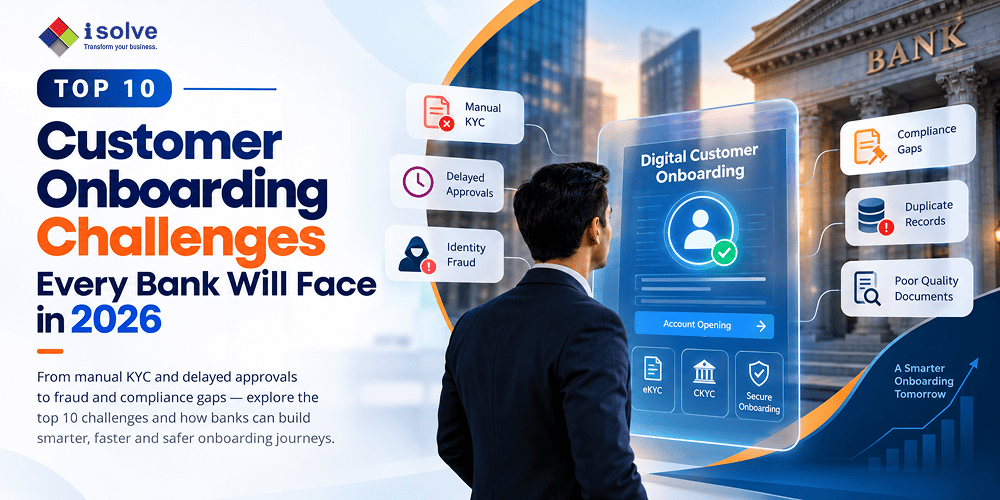
Manual KYC, delayed approvals, identity fraud and changing compliance requirements are making digital customer onboarding more complex. Discover how banks can overcome these challenges with smarter, secure and automated banking KYC software.
A customer wants to open a savings account, apply for a personal loan or start a new banking relationship. They expect a simple digital journey, quick verification and minimal paperwork. Yet, behind the scenes, banks often deal with disconnected systems, repetitive document checks, manual data entry and multiple compliance requirements.
This creates a familiar problem: customers expect instant service, but onboarding processes can still take days when documents require correction, verification is delayed or applications need manual review.
In 2026, digital customer onboarding is no longer just about moving account-opening forms online. It is about connecting identity verification, document intelligence, fraud prevention, regulatory compliance and customer experience into one coordinated workflow.
For banks operating in India, the evolving Central KYC Records Registry (CKYCRR) ecosystem, periodic KYC updates, digital identity verification and data-protection expectations make this transformation particularly important. The Reserve Bank of India’s KYC framework continues to evolve, including amendments issued in 2025. Banks must therefore build onboarding processes that can adapt to regulatory changes without compromising operational efficiency or customer trust.
At iSolve Technologies, we help financial institutions modernise these journeys through digital onboarding, eKYC and CKYC automation, document management, Aadhaar masking and customer de-duplication capabilities.
Let us explore the top 10 customer onboarding challenges banks will face in 2026—and how technology can help address them.
Manual Know Your Customer (KYC) verification remains a significant operational challenge when banks depend on employees to inspect identity documents, enter customer information, cross-check records and route applications for approval.
Even a small data-entry error can trigger additional verification, document resubmission or application delays. At scale, these repetitive tasks consume valuable employee time and make it difficult to deliver a consistent onboarding experience.
How banks can overcome it
Banks can automate document capture, optical character recognition (OCR), data extraction, identity validation and workflow routing. Instead of repeatedly entering information, authorised teams can review extracted data and focus on exceptions that genuinely require human judgement.
How iSolve Technologies helps: Our digital customer onboarding and eKYC solutions support document upload, automated data extraction, identity verification and API-based integration with existing banking systems. This helps reduce repetitive work while enabling a more consistent onboarding journey.
Explore our Digital Customer Onboarding Software.
A customer who starts an account-opening journey may abandon it if the process involves repeated uploads, unclear instructions, slow verification or multiple visits to a branch.
These delays affect more than customer satisfaction. They can reduce completed applications, increase acquisition costs and prevent banks from converting interested prospects into active customers.
How banks can overcome it
A streamlined onboarding journey should guide customers through each step, validate information early and clearly communicate what is required next. Straight-through processing can handle eligible applications automatically, while incomplete or unusual cases are routed to the appropriate team.
Banks should also track where applicants abandon the journey, which verification steps generate the most failures and how long each stage takes.
How iSolve Technologies helps: Our digital onboarding capabilities support paperless account opening, integrated eKYC and CKYC workflows, configurable journeys and connections to core banking and customer management systems. Banks can also explore self-service onboarding options to make account opening more convenient.
Digital channels make banking more accessible, but they also introduce risks associated with manipulated documents, impersonation, fraudulent identities and attempts to create duplicate customer records.
A document that appears genuine is not, by itself, sufficient evidence that the applicant is the person they claim to be. Banks need layered verification rather than relying on a single check.
How banks can overcome it
A risk-based onboarding workflow can combine document validation, identity checks, face matching, liveness detection where appropriate, duplicate detection and additional review for suspicious cases.
Automated checks should support—not replace—risk assessment and human investigation where required. Banks should also maintain clear records of verification outcomes and exceptions.
How iSolve Technologies helps: Our eKYC and digital onboarding capabilities support document verification, facial matching and liveness detection, with configurable workflows and risk checks. Our customer de-duplication solution helps identify potentially repeated identities across customer records.
Explore eKYC Verification Software and Customer De-Duplication Software.
KYC compliance is not a one-time activity. Banks must collect and validate the appropriate customer information, maintain accurate records, complete required submissions and respond to changes in applicable regulatory requirements.
The evolving CKYCRR ecosystem makes data quality, structured submissions, validation and operational visibility increasingly important. Incorrect or incomplete information can lead to rejected submissions, additional work and delays in completing customer records.
A key challenge for 2026 is ensuring that onboarding technology can accommodate updated requirements without forcing teams to rebuild their entire process each time a workflow changes.
How banks can overcome it
Banks should prioritise configurable compliance workflows, pre-submission validation, structured data formatting, maker-checker controls, submission-status monitoring and auditable records.
Compliance teams should regularly review their processes against current RBI directions, CERSAI requirements and other applicable rules. Technology supports compliance execution, but institutions remain responsible for interpreting and meeting their obligations.
How iSolve Technologies helps: Our iFlow CKYC platform supports CKYC search and download, structured data preparation, validation, automated submission workflows, duplicate checks and status tracking. Our CKYC 2.0-focused capabilities are designed to help financial institutions adapt their processes to the evolving registry ecosystem.
Explore our CKYC Compliance Software Solution and CKYC 2.0 Compliance Software Solution.
Customer documents can arrive in different formats, with unclear images, missing fields, inconsistent names or mismatched addresses. When these documents are reviewed manually, identifying and correcting every discrepancy becomes time-consuming.
The problem becomes more complicated when banks receive applications through mobile apps, branches, field agents and partner channels.
How banks can overcome it
Intelligent document processing can classify documents, extract relevant fields, check for missing information and flag inconsistencies before an application reaches the approval stage.
Banks should also provide clear instructions when customers need to resubmit a document, rather than leaving them uncertain about why their application has stalled.
How iSolve Technologies helps: Our digital onboarding and document management capabilities support OCR-based data extraction, document classification, structured information capture and workflow-based review. These capabilities help banks create more organised, traceable document-processing journeys.
Explore our Document Management System Software.
Digital onboarding involves sensitive personal information. Poor handling of identity documents, excessive data access or unnecessary exposure of Aadhaar numbers can create privacy, security and compliance risks.
Banks need to consider how sensitive information is collected, masked, stored, accessed and used throughout the customer lifecycle—not just during initial verification.
How banks can overcome it
Financial institutions should implement appropriate Aadhaar masking, secure storage, encryption, role-based access controls and audit logging. Aadhaar-related workflows must follow the applicable legal and UIDAI requirements, including the relevant rules governing authentication, offline verification, storage and use.
A security-first approach should also consider legacy records and documents already held within the organisation.
How iSolve Technologies helps: Our iMask Aadhaar masking solution supports automated identification and masking of Aadhaar information in supported document formats. Our Aadhaar Data Vault solution provides tokenisation, controlled access, encryption and traceable access logs to help protect sensitive data.
Explore Aadhaar Masking Software and Aadhaar Data Vault Software.
A customer may interact with the same financial institution through a savings account, loan application, investment product or another business unit. If each journey creates a separate record without appropriate matching, the bank can end up with fragmented customer information.
Duplicate records make it harder to maintain consistent customer data, increase reconciliation effort and complicate KYC reviews. They can also create operational blind spots when teams cannot easily establish whether two records relate to the same individual.
How banks can overcome it
Banks should implement customer de-duplication using appropriate identifiers, demographic matching and configurable exact or fuzzy matching rules. Potential matches should be reviewed according to defined business rules, with approvals and audit trails for record consolidation.
Automated matching should be designed carefully to avoid incorrectly merging different individuals with similar details.
How iSolve Technologies helps: Our de-duplication solution supports real-time and batch matching, configurable matching rules, duplicate identification and consolidated customer records across relevant workflows.
Many banks operate a complex technology environment involving core banking systems, customer relationship management platforms, loan origination systems, document repositories, verification services and compliance applications.
When these systems do not exchange information effectively, employees may need to re-enter data, switch between applications or manually check application statuses. This creates avoidable delays and makes end-to-end process monitoring difficult.
How banks can overcome it
Banks should look for API-first onboarding platforms that connect existing systems and coordinate information exchange across the customer journey.
A phased integration strategy can help institutions modernise workflows without immediately replacing their core banking infrastructure. Standardised interfaces, access controls, monitoring and exception handling are essential to dependable integrations.
How iSolve Technologies helps: Our digital onboarding ecosystem supports API-based integration with core banking systems, CRMs, loan origination platforms and other relevant services. Banks can connect verification, document management and compliance processes within a more coordinated workflow.
Explore our Fintech APIs Marketplace.
Customer onboarding does not end when an account is opened. Banks must also manage periodic KYC updates, customer information changes and other applicable review requirements throughout the relationship.
When Re-KYC depends heavily on manual follow-ups, banks may struggle to identify due cases, communicate with customers, collect updated information and track completion across large customer portfolios.
How banks can overcome it
Banks can use automated reminders, eligibility rules, self-service update journeys, document validation and dashboards that track pending cases. Applications requiring additional verification should be routed to authorised staff.
The process must reflect the applicable customer risk category and current regulatory directions; not every customer should automatically be subjected to an identical update process.
How iSolve Technologies helps: Our Re-KYC verification solution supports automated workflows, customer notifications, document validation, exception handling and status reporting. It is designed to help financial institutions manage periodic KYC updates through digital and assisted channels.
Explore Re-KYC Verification Software.
As banks expand their digital services, onboarding volumes and verification requirements can increase across channels and customer segments. Without reliable operational data, management may struggle to identify bottlenecks, monitor service-level agreements (SLAs) or understand why applications remain pending.
A process that works for a limited number of applications may become inefficient when transaction volumes rise.
How banks can overcome it
Banks should monitor onboarding completion rates, turnaround times, application drop-offs, document rejection reasons, duplicate matches, manual-review queues and compliance submission statuses.
Dashboards and exception reports can help operations teams prioritise pending applications and identify recurring problems. Capacity planning, system monitoring and performance reviews are equally important when scaling digital onboarding.
How iSolve Technologies helps: Our onboarding and CKYC workflows provide process visibility through dashboards, status tracking, audit trails and operational reporting. API-led integration and configurable workflows help banks align technology with their operational requirements as volumes grow.
Explore iSolve Digital Customer Onboarding.
Addressing these challenges requires more than implementing another standalone verification tool. Banks need a coordinated onboarding strategy that balances customer convenience, operational efficiency, fraud prevention and regulatory responsibilities.
Here are five priorities worth evaluating:
1. Automate repetitive KYC tasks. Use document intelligence, data extraction and workflow automation to reduce avoidable manual processing.
2. Validate information earlier. Identify missing fields, inconsistent documents and potential duplicate records before applications reach later approval stages.
3. Design privacy-first identity workflows. Apply appropriate masking, secure storage, access controls and auditability to sensitive customer information.
4. Connect onboarding systems. Integrate verification, CKYC, document management and core banking workflows to reduce fragmented operations.
5. Measure what matters. Track completion rates, turnaround time, manual-review volumes, error rates, drop-offs and compliance exceptions to identify opportunities for improvement.
The objective is not to automate every decision indiscriminately. It is to automate predictable tasks, maintain appropriate human oversight and give customers a clear, reliable route from application to account activation.
At iSolve Technologies, we help banks, NBFCs and financial institutions modernise digital onboarding through an integrated set of verification, compliance and workflow capabilities.
Our solutions include:
Digital Customer Onboarding: Paperless customer journeys across digital and assisted channels.
eKYC Verification: Digital identity verification, document processing and supported identity checks.
CKYC and CKYC 2.0 Workflows: Structured data preparation, CKYC search and download, submission support and status tracking.
Aadhaar Masking and Data Vault: Capabilities for protecting sensitive Aadhaar information through masking, tokenisation and controlled access.
Customer De-Duplication: Configurable matching workflows to identify potential duplicate customer records.
Re-KYC Automation: Digital workflows for periodic KYC updates, notifications and operational tracking.
Document Management and API Integration: Organised document workflows and connectivity with relevant banking systems.
The value lies in connecting these capabilities around the customer journey. Rather than treating verification, compliance and document processing as isolated activities, banks can work towards a more consistent and measurable onboarding process.
Implementation requirements, integrations and measurable outcomes will depend on each institution’s existing infrastructure, use case, configuration and operating procedures.
In 2026, banks must balance three expectations: customers want convenience, operations teams need efficiency, and compliance teams need accuracy and traceability.
Manual KYC, delayed approvals, identity fraud, poor document quality, duplicate records and fragmented systems can undermine all three. Addressing these challenges calls for a connected approach to digital customer onboarding—one that combines automation with security, regulatory awareness and appropriate human oversight.
With digital onboarding, eKYC, CKYC automation, Aadhaar protection and Re-KYC capabilities, iSolve Technologies helps financial institutions work towards faster, more consistent and better-governed onboarding journeys.
Ready to simplify banking KYC and modernise customer onboarding?
Connect with iSolve Technologies to explore how our digital onboarding and compliance solutions can fit your bank’s workflows, technology environment and operational priorities.
Digital customer onboarding is the process of acquiring and verifying a new banking customer through digital workflows. It can include identity verification, document capture, KYC checks, consent collection, compliance validation and integration with banking systems.
Key challenges include manual KYC processing, delayed approvals, identity fraud, evolving CKYC requirements, poor-quality documents, Aadhaar data protection, duplicate customer records, disconnected systems, Re-KYC delays and limited operational visibility.
Banking KYC software can automate document extraction, identity checks, data validation, workflow routing and compliance reporting. It helps reduce repetitive work and identify exceptions earlier, while keeping appropriate human review in place.
Banks can reduce avoidable delays by validating documents early, automating routine checks, integrating verification services, providing clear resubmission instructions and routing exceptions to the right teams.
Central KYC (CKYC) enables the centralised maintenance and retrieval of KYC records through India’s Central KYC Records Registry, subject to applicable requirements. Properly integrated CKYC workflows can reduce repetitive data collection and help institutions manage customer records more consistently.
iSolve Technologies offers digital customer onboarding, eKYC, CKYC compliance workflows, Aadhaar masking, Aadhaar Data Vault, customer de-duplication, Re-KYC and document management capabilities to help financial institutions streamline verification and compliance workflows.
