
 Platforms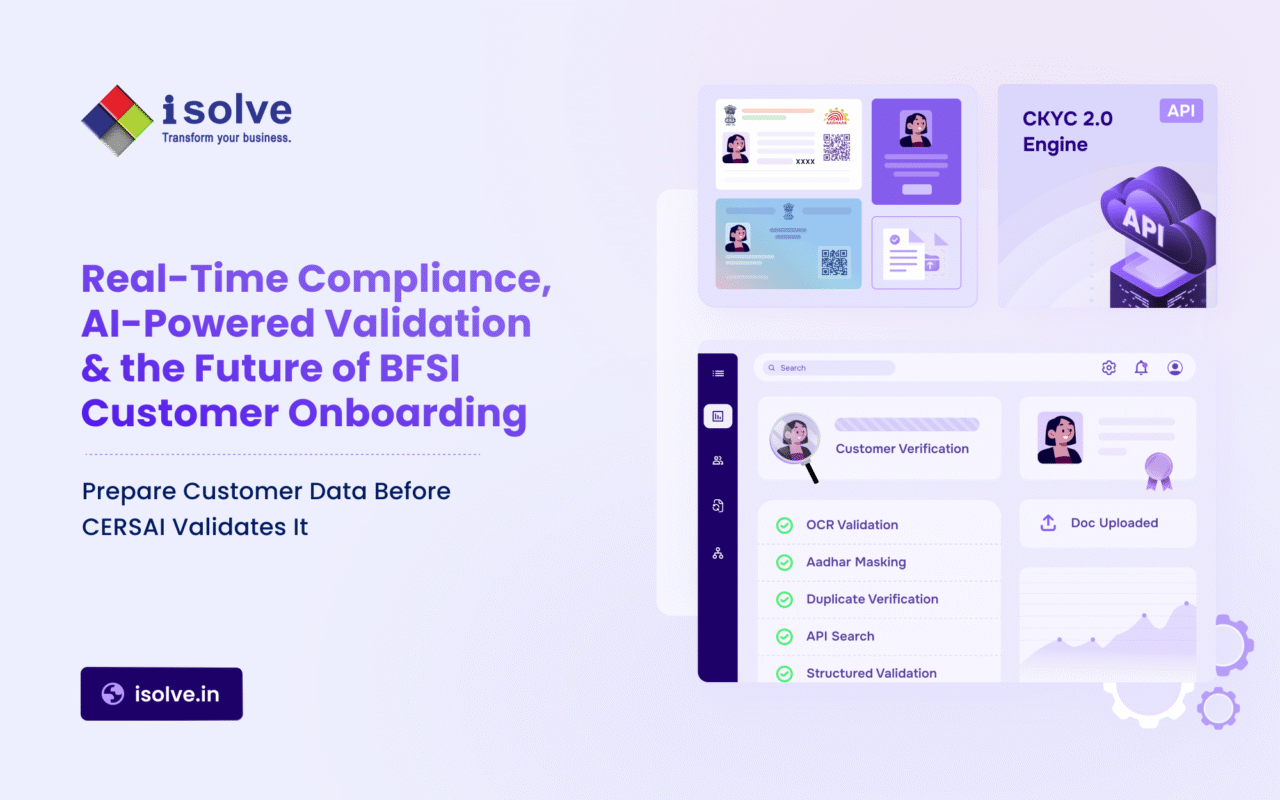
The BFSI industry is entering a new era of customer onboarding compliance.
With the evolution of CKYC 2.0, the Central Registry of Securitisation Asset Reconstruction and Security Interest of India (CERSAI) is driving a major shift toward real-time validation, structured onboarding intelligence, privacy enforcement, and faster compliance decision-making.
For Banks, NBFCs, Insurance providers, Fintechs, Securities firms, and other Reporting Entities, this is no longer just a regulatory update — it is a transformation in how customer onboarding systems are expected to operate.
Traditional onboarding models that relied on delayed validations, manual corrections, and fragmented compliance checks are rapidly becoming inadequate for the expectations of modern CKYC ecosystems.
The future now belongs to organizations that can validate customer onboarding data accurately, securely, and instantly.
In this blog, we explore:
- What CKYC 2.0 means for BFSI institutions
- Key RBI/CERSAI compliance expectations
- Scope of CKYC 2.0 implementation
- Major onboarding challenges
- Operational and business impact
- Future of real-time onboarding compliance
- ROI of modern CKYC automation platforms
- How BFSI organizations can prepare strategically
CKYC 2.0 is the next evolution of India’s Central KYC ecosystem designed to strengthen customer identity verification, improve onboarding data quality, reduce fraud risk, and enable real-time compliance readiness across the BFSI sector.
Unlike traditional CKYC workflows where customer onboarding validations could happen later in the process, CKYC 2.0 introduces a more structured, API-driven, validation-first onboarding architecture.
The focus has shifted toward:
✔ Real-time onboarding validation
✔ Structured data standardization
✔ Intelligent duplicate prevention
✔ Automated privacy enforcement
✔ Secure authentication workflows
✔ Faster onboarding certainty
This evolution is aligned with the growing regulatory emphasis on stronger KYC governance, digital onboarding integrity, fraud prevention, and operational transparency.
Why CKYC 2.0 Matters for BFSI Institutions
The BFSI sector is experiencing massive growth in digital onboarding volumes.
As customer acquisition becomes increasingly digital, regulators expect financial institutions to improve the quality, consistency, and security of onboarding data being submitted into centralized KYC ecosystems.
This is where CKYC 2.0 becomes operationally critical.
The updated ecosystem is designed to address several longstanding onboarding challenges, including:
- Inconsistent customer data quality
- Duplicate customer identities
- OCR mismatches
- Fragmented onboarding systems
- Delayed verification workflows
- Aadhaar privacy concerns
- Manual compliance dependency
- Increased fraud exposure
CKYC 2.0 encourages organizations to validate onboarding data at the source rather than relying on downstream corrections after submission.
In simple terms:
Compliance now starts before submission — not after rejection.
Although CKYC 2.0 continues evolving operationally, the broader direction of RBI/CERSAI onboarding expectations indicates stronger emphasis on:
- Real-Time Validation
Customer data is expected to be validated instantly during onboarding workflows.
This reduces delayed error correction cycles and improves onboarding certainty.
- Structured Data Standardization
Institutions must ensure customer data follows standardized structures, formats, and field-level consistency.
This improves interoperability across financial ecosystems.
- Aadhaar Privacy & Masking Controls
Privacy enforcement is becoming increasingly important within onboarding operations.
Organizations must ensure sensitive customer identity information is protected appropriately during onboarding and storage workflows.
- Intelligent Duplicate Detection
Modern CKYC ecosystems require stronger duplicate prevention mechanisms to reduce identity duplication and onboarding fraud risks.
- API-Driven Compliance Architecture
CKYC ecosystems are moving toward real-time API integrations for validation, verification, onboarding intelligence, and automated compliance workflows.
CKYC 2.0 impacts multiple layers of BFSI onboarding ecosystems.
Institutions Affected
- Banks
- NBFCs
- Insurance Companies
- Fintech Platforms
- Mutual Fund Companies
- Securities & Broking Firms
- Cooperative Banks
- Microfinance Institutions
Customer Onboarding
Real-time compliance validation becomes a critical onboarding requirement.
Digital KYC Operations
Organizations must improve onboarding accuracy and reduce manual dependency.
Data Governance
Customer data quality and structured validation become operational priorities.
Compliance Monitoring
Institutions require better visibility into onboarding exceptions, validation failures, and audit readiness.
Technology Infrastructure
Legacy onboarding systems may require modernization to support API-first validation ecosystems.
While the shift improves compliance maturity, it also introduces operational challenges.
- High First-Time Rejections
Legacy onboarding workflows often fail under real-time validation expectations.
- OCR & Data Mismatch Issues
Incorrect document extraction and inconsistent customer information continue to impact onboarding quality.
- Duplicate KIN Risks
Lack of intelligent deduplication increases operational and compliance risks.
- Manual Compliance Processes
Manual onboarding checks increase turnaround time and operational costs.
- Legacy System Limitations
Many onboarding systems were designed for delayed validation ecosystems — not instant compliance decision-making.
The direction of BFSI onboarding is becoming increasingly clear.
The future will focus on:
✔ Real-time onboarding intelligence
✔ AI-powered compliance automation
✔ Straight-through onboarding workflows
✔ Privacy-first customer onboarding
✔ Automated validation ecosystems
✔ Fraud-resistant onboarding infrastructure
✔ Faster customer acquisition with reduced risk
Financial institutions that modernize onboarding systems early will be better positioned for future regulatory expectations and digital growth.
CKYC 2.0 is not just a compliance framework.
It is the foundation for the next generation of digital onboarding ecosystems in BFSI.
Modern CKYC automation platforms deliver both compliance and business value.
Faster Customer Onboarding
Automated validation reduces manual processing time and accelerates onboarding approvals.
Reduced Operational Costs
AI-driven workflows minimize manual intervention and exception handling.
Lower Rejection Rates
Pre-submission validation improves onboarding accuracy and reduces correction cycles.
Improved Customer Experience
Faster onboarding enhances customer satisfaction and reduces drop-offs.
Stronger Audit Readiness
Structured onboarding workflows improve traceability and compliance reporting.
Better Scalability
Organizations can process higher onboarding volumes without proportional operational expansion.
Modern AI-powered CKYC platforms act as real-time compliance intelligence layers between onboarding systems and centralized KYC ecosystems.
These platforms help organizations:
✔ Validate onboarding data before submission
✔ Detect OCR inconsistencies automatically
✔ Enable Aadhaar masking workflows
✔ Prevent duplicate identities
✔ Structure onboarding data correctly
✔ Improve onboarding success rates
✔ Reduce compliance risk exposure
✔ Accelerate onboarding turnaround times
The goal is simple:
Enable onboarding certainty before compliance validation occurs.
CKYC 2.0 marks a major transformation in how BFSI institutions approach onboarding, compliance, and customer identity verification.
The industry is moving toward a future where:
- data accuracy matters instantly,
- privacy enforcement is expected upfront,
- onboarding workflows must be intelligent,
- and compliance systems must operate in real time.
Organizations that continue relying on fragmented, manual, and delayed onboarding models may struggle to meet evolving onboarding expectations.
The future belongs to BFSI institutions that invest in:
- real-time validation,
- AI-driven onboarding intelligence,
- automated compliance ecosystems,
- and scalable digital onboarding infrastructure.
Modern CKYC Compliance Platforms are no longer optional operational tools.
They are becoming strategic infrastructure for the future of BFSI onboarding.

Modernize your onboarding ecosystem with AI-powered real-time validation, automated Aadhaar masking, intelligent duplicate detection, and 100% CERSAI-ready onboarding workflows.
Modernize your onboarding ecosystem with AI-powered real-time validation, automated Aadhaar masking, intelligent duplicate detection, and 100% CERSAI-ready onboarding workflows.