
 Platforms
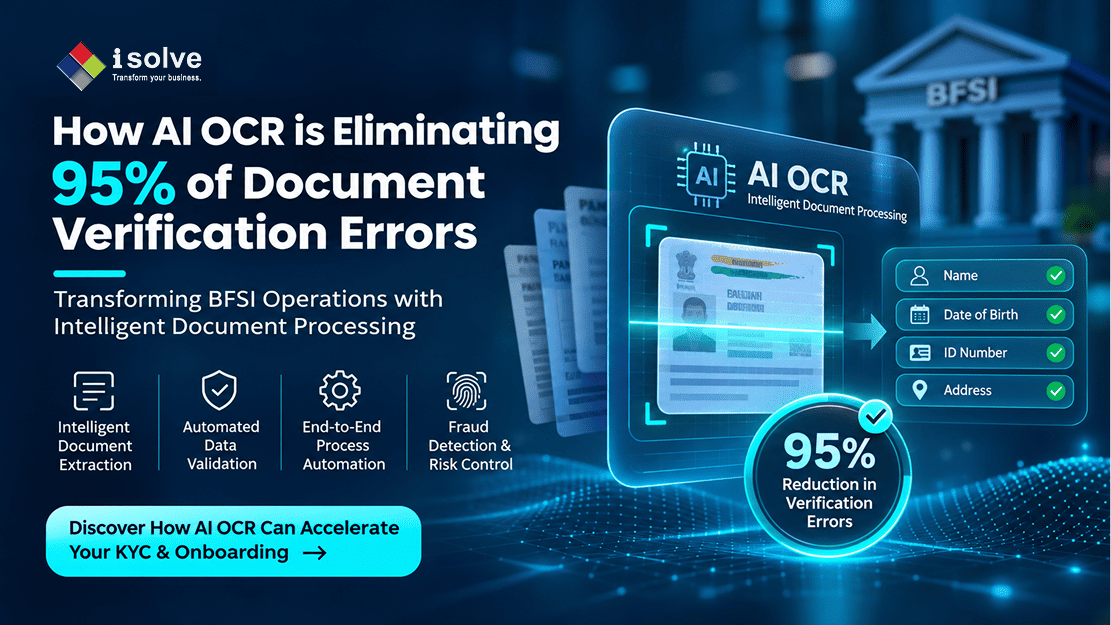
Manual document verification is becoming a costly bottleneck for banks, NBFCs, insurance companies, and fintech organizations. AI-powered Optical Character Recognition (OCR), combined with Intelligent Document Processing (IDP), is transforming how financial institutions capture, extract, validate, and process customer information.
Imagine processing hundreds or thousands of customer documents every day without repeatedly entering names, dates of birth, identification numbers, or addresses manually. No more unnecessary rework caused by typing mistakes. No more delays because important information was overlooked during document verification.
This is where AI OCR is changing the game.
For BFSI organizations, document verification is not simply about reading information from an uploaded document. It involves extracting accurate data, validating customer information, identifying inconsistencies, detecting potential fraud indicators, and maintaining regulatory compliance.
At iSolve Technologies, we believe the future of digital banking lies in intelligent, connected, and automated document processing systems that make customer onboarding faster, more accurate, and more secure.
Let’s explore how AI OCR and Intelligent Document Processing are transforming document verification across the BFSI ecosystem.
Why Traditional Document Verification Is Becoming a Challenge for BFSI
Banks and financial institutions process a wide variety of documents, including PAN cards, Aadhaar documents, passports, driving licences, address proofs, bank statements, income documents, and business registration certificates.
Traditionally, employees manually review these documents and enter the information into internal systems.
Although this process may work for smaller volumes, it becomes increasingly difficult when institutions handle thousands of customer applications.
Some common challenges include:
Manual Data Entry Errors: Incorrect names, identification numbers, dates, and addresses caused by repetitive data entry.
Document Quality Issues: Blurred images, handwritten information, low-resolution scans, and incorrectly uploaded documents.
Inconsistent Information: Differences between customer-submitted documents and application records.
Delayed Verification: Manual reviews increase turnaround time and create operational bottlenecks.
Fraud and Identity Risks: Altered documents, suspicious information, and duplicate customer records can go unnoticed.
Compliance Challenges: Incomplete or incorrectly structured customer records can result in verification and regulatory submission issues.
For BFSI organizations, even a small data-entry mistake can lead to application rejection, repeated customer interactions, operational expenses, and compliance complications.
The solution is not simply to digitize documents. It is to make document processing intelligent.
What Is AI OCR and How Does It Work?
AI OCR (Artificial Intelligence-Powered Optical Character Recognition) is a technology that identifies and extracts text from digital documents, scanned images, and photographs using advanced recognition models.
Traditional OCR primarily converts printed or scanned text into machine-readable information.
AI OCR takes this further by combining machine learning, document intelligence, contextual recognition, and automated validation to understand and process document information more intelligently.
For example, when a customer uploads a PAN card during digital onboarding, AI OCR can:
Identify the uploaded document as a PAN card.
Recognize and extract the customer’s name, PAN number, and other relevant information.
Structure the extracted information into readable data fields.
Validate the extracted information against predefined formats and business rules.
Identify missing fields, inconsistent information, or potential verification concerns.
Pass validated information to the relevant KYC or onboarding workflow.
Instead of depending entirely on employees to read and manually enter every detail, financial institutions can automate significant portions of the document verification process.
Intelligent Document Processing: Beyond Traditional OCR
AI OCR is an important component of Intelligent Document Processing (IDP).
While OCR focuses on text recognition and extraction, IDP brings together multiple technologies to automate the complete document processing lifecycle.
For BFSI organizations, an effective Intelligent Document Processing workflow generally involves four important stages.
1. Intelligent Document Capture and Data Extraction
The first step is capturing customer documents from digital channels, mobile applications, branch operations, or other integrated systems.
AI OCR identifies document types and extracts relevant information from supported formats, including PDFs, scanned images, and photographs.
Depending on the document and recognition model, it can process structured and semi-structured information from identity documents, financial records, and application forms.
Business benefit: Reduces repetitive manual data entry and makes customer information available in a structured format.
2. Automated Data Validation and Cross-Verification
Extracting information is only the beginning. The extracted information must also be validated.
For example, a customer’s name, date of birth, and identification number may need to match the information submitted during the onboarding process.
Intelligent Document Processing can apply predefined validation rules to identify:
Missing or incorrectly formatted information.
Differences between application data and document data.
Invalid identification number formats.
Inconsistent customer details across multiple documents.
Duplicate customer information.
When integrated with verification services and business workflows, the system can route exceptions for further review.
Business benefit: Helps reduce data inconsistencies, prevent avoidable application rejections, and improve first-time-right processing.
3. Intelligent Automation and Workflow Management
Once documents are captured and validated, the extracted information can automatically move into the next stage of the customer lifecycle.
For example, during a loan application, an IDP-enabled workflow can process identity documents, extract applicant details, organize supporting documents, and route information to the relevant verification and approval stages.
Similarly, during account opening, extracted information can support eKYC, CKYC, customer profile creation, and document management processes.
With API-driven integrations, organizations can connect document processing capabilities with existing banking applications, CRM platforms, loan origination systems, and core banking environments.
Business benefit: Reduces repetitive operational tasks, improves processing speed, and creates more consistent customer journeys.
4. Fraud Indicators and Risk-Based Document Screening
Document verification also plays an important role in identifying potential identity and document fraud.
AI-powered document processing can help flag suspicious patterns such as:
Unexpected differences in customer information.
Inconsistent document fields.
Missing or unusual document elements.
Duplicate customer records.
Potentially manipulated document images.
However, OCR alone cannot establish whether a document is genuine. Authenticity checks require additional verification capabilities, such as document security-feature analysis, trusted-source validation, identity verification, and risk-based screening.
Combining these capabilities helps financial institutions identify potential risks earlier and direct suspicious cases for appropriate investigation.
Business benefit: Strengthens document verification controls and supports more informed risk assessment.
How AI OCR Can Reduce Document Verification Errors by Up to 95%
The biggest advantage of AI OCR is its ability to reduce the manual activities that frequently introduce errors into document verification workflows.
Consider a traditional KYC process in which employees manually read customer documents, enter information into an application, and cross-check the details against supporting records.
Every additional manual interaction creates another opportunity for mistakes.
AI OCR minimizes this dependency by automating document recognition, data extraction, and rule-based validation.
Here is how it contributes to better accuracy:
| Traditional verification | AI OCR-enabled verification |
|---|---|
| Manual information entry | Automated data extraction |
| Repetitive document reading | Intelligent document recognition |
| Manual field comparison | Automated rule-based validation |
| Delayed error identification | Earlier identification of inconsistencies |
| Separate document handling | Integrated document workflows |
| Repeated manual corrections | Exception-based review and correction |
What does a 95% reduction mean?
For example, if a financial institution records 100 document-processing errors within a defined baseline period, a 95% reduction would mean reducing those errors to five under comparable operating conditions.
This is an illustrative improvement scenario, not a universal AI OCR accuracy benchmark. Actual results depend on document quality, recognition accuracy, validation rules, workflow integration, and the institution’s existing error baseline.
The important takeaway is that AI OCR shifts document verification from repetitive manual data entry towards intelligent extraction, automated validation, and controlled exception handling.
How iSolve Technologies Is Transforming BFSI Document Processing
At iSolve Technologies, we understand that financial institutions need more than standalone document scanning capabilities.
They need connected solutions that bring together document intelligence, identity verification, regulatory compliance, data security, and digital customer onboarding.
Our BFSI technology ecosystem is designed to support these requirements through integrated digital solutions.
1. AI-Powered eKYC Verification
Our AI-powered eKYC solution combines advanced OCR and machine learning capabilities to support automated customer information extraction and identity verification.
It supports document-based verification involving Aadhaar, PAN, Voter ID, driving licences, and other supported identity documents.
Key capabilities include:
OCR-based document data extraction.
Automated customer information validation.
Multi-document and regional language support.
Face matching and liveness detection.
Aadhaar XML and offline eKYC support.
API-based integration with banking and fintech applications.
Explore: https://isolve.in/ekyc-verification-software-solution/
2. Intelligent Document Management System
Extracting information is only one part of document management. Financial institutions must also securely store, organize, retrieve, and track customer documents.
Our AI-powered Document Management System helps BFSI organizations manage digital and physical documents through intelligent document classification, smart indexing, automated workflows, version control, and audit trails.
Key capabilities include:
Intelligent document classification.
Smart search and metadata indexing.
Automated document workflows and approvals.
Multi-format document digitization.
Role-based access and data encryption.
Compliance dashboards and audit trails.
Explore: https://isolve.in/document-management-system-software/
3. iFlow CKYC Compliance Platform
Incorrectly structured customer information can create problems during regulatory submissions.
Our iFlow CKYC platform helps financial institutions automate CKYC-related workflows, including customer data formatting, CKYC uploads and downloads, duplicate detection, and compliance monitoring.
With iFlow CKYC 7.0, institutions can support evolving CKYCRR 2.0 requirements through automated validation, structured data preparation, and compliance-oriented workflows.
Explore: https://isolve.in/ckyc-2-0-compliance-software-solution/
4. Automated Aadhaar Masking and Data Protection
Handling sensitive identity information requires strong privacy and security controls.
Our iMask Aadhaar Masking solution helps organizations identify Aadhaar documents and automatically mask sensitive information, including Aadhaar numbers, QR codes, barcodes, and photographs.
It also supports multiple document formats, batch processing, and integration with document management systems.
Explore: https://isolve.in/aadhaar-masking-software-solutions/
5. Intelligent Customer De-Duplication
Duplicate customer records can create operational inefficiencies and increase identity-related risks.
Our De-Duplication solution helps banks, NBFCs, and insurance providers identify duplicate customer information and maintain a more consistent customer identity across business systems.
Explore: https://isolve.in/de-duplication-software-solution/
Together, these capabilities help financial institutions move towards a more connected document verification and customer onboarding ecosystem.
Key Business Benefits of AI OCR for Banks and NBFCs
Implementing AI OCR and Intelligent Document Processing can deliver operational and customer experience improvements across multiple BFSI functions.
1. Improved Verification Accuracy
Automated extraction and validation reduce dependence on repetitive manual data entry and help identify information inconsistencies earlier.
2. Faster Customer Onboarding
Documents can be processed and routed automatically, reducing unnecessary waiting periods and repeated interactions.
3. Lower Operational Workload
Employees can spend less time on repetitive document reading and data entry and more time handling exceptions and higher-value verification activities.
4. Stronger Compliance Readiness
Structured data, document tracking, audit trails, and integrated compliance workflows help institutions maintain better control over their verification processes.
5. Better Customer Experience
Faster document processing means fewer unnecessary follow-ups, reduced application friction, and smoother digital onboarding journeys.
6. Scalable Document Processing
Automated workflows help financial institutions manage increasing document volumes without depending entirely on proportional increases in manual processing resources.
The Future of Document Verification Is Intelligent, Automated, and Connected
The next generation of BFSI operations will not depend on OCR technology alone.
It will combine AI OCR, Intelligent Document Processing, machine learning, API integrations, automated verification, and secure document management into a unified digital ecosystem.
As digital banking, paperless account opening, loan origination, and remote customer onboarding continue to evolve, financial institutions need document processing systems that can handle information accurately while supporting security and compliance requirements.
The real opportunity is not simply to eliminate manual data entry. It is to build a connected verification process where information is captured once, validated intelligently, and securely made available to the right systems.
At iSolve Technologies, we are committed to helping banks, NBFCs, insurance companies, and fintech organizations accelerate this transformation through intelligent digital onboarding, KYC automation, document management, and compliance solutions.
Ready to reduce document verification errors and accelerate your BFSI operations?
Discover how iSolve Technologies can help transform your document verification and customer onboarding workflows with AI-powered automation.

Frequently Asked Questions (FAQs)
AI OCR in banking is a technology that uses artificial intelligence and optical character recognition to identify, extract, and structure information from customer documents. It helps automate KYC verification, customer onboarding, and document processing.
Intelligent Document Processing combines OCR, AI, machine learning, data extraction, validation, and workflow automation to process documents with minimal manual intervention.
AI OCR reduces errors by automating information extraction, applying predefined validation rules, identifying missing fields, and flagging inconsistencies for further review.
AI OCR can identify suspicious information, inconsistencies, and potential document anomalies. However, document authenticity requires additional security-feature analysis and independent verification mechanisms.
Depending on the solution’s supported formats and recognition capabilities, AI OCR can process PAN cards, Aadhaar documents, passports, driving licences, voter IDs, bank statements, and other KYC-related documents.
